Disclaimer: The information in this guide is for educational purposes only and does not constitute financial advice. Gambling involves financial risk; please play responsibly. If you or someone you know has a gambling problem, contact organisations such as BeGambleAware or GamCare for support.

Last updated: July 2026

Roulette Guide: Rules, Bets, Strategy and Live Play

Roulette is, at its core, a simple game. A wheel spins, a ball bounces, and the pocket it lands in decides everything. But between that simplicity and the actual betting layout, there is quite a bit worth understanding before you place a single chip.

Whether you are completely new to the roulette table or coming back after a break, this guide walks through the full picture. We cover the rules of the game, every bet type with exact payouts, the real differences between roulette variants, popular betting strategies with worked examples, live dealer formats, demo mode advantages, common myths, and what to check before choosing a casino. No income promises, no hype. Just the information you need to play roulette with your eyes open.

In this guide you will learn:

  • What roulette is and how a round works, step by step
  • The roulette wheel and table layout explained
  • Every inside and outside bet with payout ratios
  • European vs American vs French roulette, and why the math matters
  • Strategies like Martingale, Fibonacci, and D'Alembert with worked examples
  • How live roulette differs from RNG online roulette and demo mode
  • Common beginner mistakes and debunked myths
  • How to pick a trustworthy online casino for real-money play
  • A practical FAQ answering the most common player questions
Roulette Guide Rules, Bets, Strategy and

What Roulette Is and How the Game Works

Roulette is a casino game built entirely on chance. Players place chips on a betting layout, predicting where a small ball will come to rest on a spinning numbered wheel. The word "roulette" comes from the French for "little wheel," and the game has been a centrepiece of casinos since the 18th century. That is a long run for any game, and there is a reason it has lasted.

The core mechanic is straightforward: you choose your bet, the dealer (or a Random Number Generator in online versions) spins the wheel and releases the ball in the opposite direction, and the pocket where the ball settles determines the winner. Bets can target a single number, a small group of numbers, a colour, odd or even, or broader groupings.

What Roulette Is and How the

"Roulette is a game of pure chance with independent outcomes: the probability of the ball landing on any given number is constant and does not depend on previous spins." - UNLV Honors Thesis on Roulette.

Despite being luck-based, roulette offers real depth in how you manage risk. The layout, bet types, and payout ratios are fixed. You cannot control where the ball lands, but you absolutely can control the type and size of risk you take on each spin. That distinction matters more than most beginners realise.

The Roulette Wheel and Table Layout

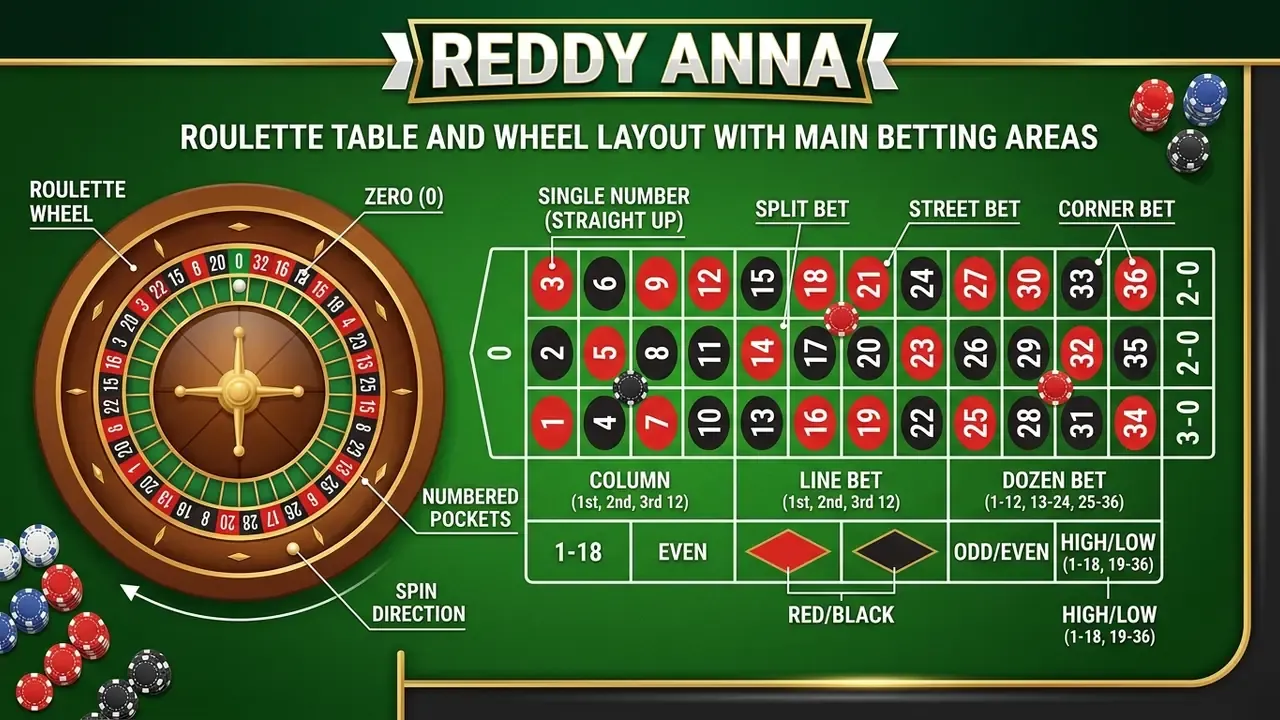
The roulette wheel is a precision-engineered spinning disc with numbered pockets around its edge. Here is something that trips up newcomers: the order of numbers on the wheel does not match the sequential layout on the table. They follow a fixed, non-sequential pattern designed to distribute odd, even, red, black, high, and low numbers as evenly as possible.

There are two primary wheel designs found in online casinos and physical venues:

  • European wheel: 37 pockets, covering numbers 1 to 36 plus a single green zero (0).
  • American wheel: 38 pockets, covering numbers 1 to 36 plus both a green zero (0) and a green double zero (00).

The colours are functional, not decorative:

  • Red and black pockets alternate for numbers 1 to 36 and form the basis for one of the most popular bets.
  • Green pockets (0 and, in American roulette, 00) are neither red nor black. They exist to give the house its mathematical edge.

In European roulette, the probability of winning an even-money bet such as odd/even is 18/37 (approximately 48.6%). In American roulette, that probability drops to 18/38 (approximately 47.4%) because the extra 00 pocket adds one more losing outcome without adding a winning one. - University of California San Diego, Notes on Games of Chance.

That difference looks small on paper. Over hundreds of spins, though, it adds up.

In front of the wheel sits a green felt table covered in numbers and betting zones. The numbers 1 to 36 are laid out in 12 rows of three, forming a grid. At the top of the grid sit the 0 (and 00 in American roulette) spaces.

Around the edges and bottom of the grid are areas for broader bets:

  • Red or Black
  • Odd or Even
  • Low (1 to 18) or High (19 to 36)
  • Dozens (1st 12, 2nd 12, 3rd 12)
  • Columns (three vertical columns of 12 numbers each)

In some European and French roulette tables, there is also a racetrack - a miniature oval representation of the wheel used for placing call bets (also known as announced bets). These include sector-based wagers like Voisins du Zero, Tiers du Cylindre, Orphelins, and Jeu Zero, which cover specific sequences of numbers as they appear on the physical wheel rather than on the table grid.

Every area of the roulette table corresponds to a specific bet type. That gives you flexibility in how you want to play, whether you are feeling bold with a single-number wager or cautious with an even-money outside bet.

The Roulette Wheel and Table Layout

How a Roulette Round Is Played

A roulette round follows the same pattern every time, whether you are at a physical casino table or playing roulette online:

  1. Place your bets: Choose your chip value and place chips on the layout. You can make multiple bets per round. Most players, even experienced ones, combine two or three bet types.
  2. Betting closes: The dealer announces "No more bets" (or "Rien ne va plus" in French tables). After this call, no chips may be added or moved.
  3. The spin: The dealer spins the wheel in one direction and releases the ball in the opposite direction. In online RNG roulette, the software generates the result instantly, though an animation plays for the experience.
  4. The result: The ball settles into a numbered pocket. The dealer marks the winning number on the table.
  5. Payouts and clearing: Losing bets are collected first. Then winning bets are paid out according to fixed payout ratios. After payouts, the table resets for the next round.

The whole cycle takes roughly 60 to 90 seconds at a live table. Online, it can be faster. The roulette game has a fixed order, and every round is independent of the last. That is worth repeating: no spin has any memory of the one before it.

How a Roulette Round Is Played

Roulette Rules Every Player Should Know

Before you play roulette for real money or even in demo mode, understanding the basic rules saves confusion and, frankly, money. The roulette rules are consistent across most casinos, though minor variations exist between formats.

When and Where to Place Bets

You can place bets on the roulette table any time the round is open. In live roulette, the dealer will signal when betting begins and when it closes. In online formats, a timer or visual cue handles this.

Where you place your chip on the table determines the type of bet. Chips placed directly on a number are inside bets. Chips placed on the outer sections (red/black, odd/even, dozens, columns) are outside bets. You can also place chips on the borders between numbers to cover small groups, which we will explain in the bets section below.

A few practical points worth noting:

  • Most tables have minimum and maximum bet limits. These apply separately to inside and outside bets.
  • You can combine multiple bets in a single round. For example, you might place a straight bet on number 17 and an outside bet on red at the same time.
  • In live dealer roulette, the betting window is shorter than in standard online roulette. Keep that in mind if you like to think before placing.
When and Where to Place Bets

What Determines the Winning Number

The winning number is determined entirely by where the ball comes to rest on the wheel after the spin. In a physical casino or live roulette session, this is a mechanical outcome influenced by the speed of the wheel, the force of the ball release, and minor physical variables. In RNG online roulette, a certified random number generator produces the result.

Either way, the outcome is independent. The roulette game has no memory. If red has come up ten times in a row, the probability of red on the next spin remains exactly the same. This is one of the most important roulette rules to internalise, because it protects you from a very common and costly thinking error.

What Determines the Winning Number. The

Roulette Bets and Payouts Explained

This is where the roulette game gets interesting. The variety of bets is what gives roulette its depth. Every bet on the roulette table has a fixed payout ratio, and understanding these helps you decide how much risk you want to take.

Inside Bets on the Roulette Table

Inside bets are placed directly on the numbered grid. They cover fewer numbers, which means lower odds of winning but higher payouts when you do.

Here are the main inside bet types:

  • Straight (single number):Place your chip squarely on one number. Pays 35 to 1. The probability on a European wheel is 2.7%.
  • Split (two numbers):Place your chip on the line between two adjacent numbers. Pays 17 to 1.
  • Street (three numbers):Place your chip at the edge of a row of three. Pays 11 to 1.
  • Corner (four numbers):Place your chip at the intersection of four numbers. Pays 8 to 1.
  • Six Line (six numbers):Place your chip at the intersection of two adjacent rows. Pays 5 to 1.
Inside Bets on the Roulette Table

In American roulette, there is also a Five-Number Bet (also called the "basket bet") covering 0, 00, 1, 2, and 3. It pays 6 to 1 but carries a house edge of 7.89%, which is the worst bet on the entire table. Most experienced players avoid it entirely.

Outside Bets and Lower-Risk Options

Outside bets cover larger groups of numbers. The payouts are smaller, but you win more often. For many players, especially beginners, these are a more comfortable starting point.
  • Red or Black:Pays 1 to 1 (even money). Covers 18 numbers.
  • Odd or Even:Pays 1 to 1. Covers 18 numbers.
  • Low (1-18) or High (19-36):Pays 1 to 1. Covers 18 numbers.
  • Dozens (1st 12, 2nd 12, 3rd 12):Pays 2 to 1. Covers 12 numbers.
  • Columns:Pays 2 to 1. Covers 12 numbers in a vertical column.
Outside Bets and Lower-Risk Options. Outside

A quick note on even-money bets: they are not truly 50/50. On a European wheel, the single zero means you have 18 winning pockets out of 37, not 36. On an American wheel, it is 18 out of 38. The house edge comes from that gap.

Roulette Bets and Payouts Summary

Bet TypeNumbers CoveredPayoutEuropean Win Probability
Straight135 to 12.7%
Split217 to 15.4%
Street311 to 18.1%
Corner48 to 110.8%
Six Line65 to 116.2%
Dozens122 to 132.4%
Columns122 to 132.4%
Red/Black181 to 148.6%
Odd/Even181 to 148.6%
Low/High181 to 148.6%

The pattern is clear: the more numbers you cover, the more often you win, but the less you win each time. No bet type changes the house edge on a European wheel (2.7%) or an American wheel (5.26%). The payouts are structured so the casino always has a small mathematical advantage over time.

European Roulette vs American Roulette

This is not a minor detail. The version of roulette you play directly affects your odds.

Why the Wheel Layout Changes the House Edge

European roulette has 37 pockets (numbers 1 to 36 plus a single zero). American roulette has 38 pockets (the same numbers plus a double zero). That one extra pocket changes everything.

Here is the math, kept simple. On a straight bet, the payout is 35 to 1 regardless of the version. But the true odds of hitting a single number are 1 in 37 on a European wheel and 1 in 38 on an American wheel. The payout does not adjust to reflect the extra pocket. That gap is where the house edge lives.

  • European roulette house edge: 2.7%
  • American roulette house edge: 5.26%

In practical terms, for every 1,000 INR you wager over time on European roulette, you can expect to lose roughly 27 INR on average. On American roulette, that expected loss nearly doubles to about 53 INR. These are long-run averages, not guarantees for any single session. But over hundreds of spins, the difference is real and measurable.

French roulette deserves a mention here. It uses the same 37-pocket European wheel but adds two special rules: La Partage and En Prison. Both rules return half your even-money bet (or hold it for the next spin) when the ball lands on zero. This drops the effective house edge on even-money bets to just 1.35%, making French roulette the most player-friendly version available.

Why the Wheel Layout Changes the

Which Version Is Better for New Players

If you are just starting out, European roulette is the clearest choice. The rules are simpler than French roulette, and the house edge is nearly half that of American roulette. Most online casinos offer all three versions, so you are not locked in.

A common marketing claim is that "all roulette versions offer the same excitement." That is true for the experience. It is not true for the math. The version you choose changes your expected cost of playing. Treat this as a factual check, not a preference.

Fact check: Not all roulette versions are equal in odds. European roulette (house edge 2.7%) gives players better mathematical odds than American roulette (house edge 5.26%). French roulette with La Partage drops even-money house edge to 1.35%. Always check which version a casino offers before you start playing.

Roulette Strategy: What Can and Cannot Improve Your Results

Let us be honest about this upfront. No roulette strategy can overcome the house edge in the long run. The game is designed so the casino has a small but permanent mathematical advantage. That said, strategies can help you structure your betting, manage your bankroll, and avoid impulsive decisions. They are tools for discipline, not tools for guaranteed profit.

Betting Systems and Realistic Expectations

Several well-known betting systems exist. Here are the most common ones, with worked examples so you can see exactly how they function:

Martingale System The idea: double your bet after every loss. When you eventually win, you recover all previous losses plus a profit equal to your original bet.

Example: You start with a 100 INR bet on red. You lose. Next bet: 200 INR. Lose again. Next: 400 INR. You win. Total wagered: 700 INR. Total returned: 800 INR (400 bet + 400 winnings). Net profit: 100 INR.

The catch? It sounds clean on paper. In practice, a losing streak of just seven spins takes your bet from 100 INR to 12,800 INR. Most tables have maximum bet limits that will stop you from doubling further. And even without table limits, the risk of a long losing streak is real. The Martingale does not change the odds. It changes the shape of your risk: many small wins, but the occasional devastating loss.

Fibonacci System The idea: follow the Fibonacci sequence (1, 1, 2, 3, 5, 8, 13, 21...) for your bet sizing. After a loss, move one step forward. After a win, move two steps back.

Example with a 50 INR base unit: Bet 50, lose. Bet 50, lose. Bet 100, lose. Bet 150, win. Move back two steps, bet 50.

This system is less aggressive than Martingale. Bets grow more slowly. But the same fundamental limitation applies: no sequence of bet sizes can change the underlying probability of each spin.

D'Alembert System The idea: increase your bet by one unit after a loss, decrease by one unit after a win.

Example with a 100 INR base: Bet 100, lose. Bet 200, lose. Bet 300, win. Bet 200, win. Bet 100.

D'Alembert is the gentlest of the three. It does not chase losses as aggressively. For players who want some structure without wild swings, it is a reasonable framework. But again, it does not alter the house edge.

The honest summary: Betting systems can make your sessions more structured and help you stick to a budget. They cannot turn roulette into a profitable activity over time. If someone tells you otherwise, that is a red flag.


Betting Systems and Realistic Expectations. Several

Common Roulette Myths to Avoid

Myths cost money. Here are the ones that trip up the most players:

"The ball is due to land on red." This is the gambler's fallacy. Each spin is independent. The wheel has no memory. If black has come up 15 times in a row, the probability of red on the next spin is still 18/37 on a European wheel. Not higher, not lower.

"Dealers can control where the ball lands." In a properly regulated casino, this is not possible. The physics of a spinning wheel and a bouncing ball create outcomes that neither the dealer nor the player can predict. In online RNG roulette, the result is generated by certified software.

"Betting systems guarantee long-term profit." No system can overcome a negative expected value. The house edge is built into the payout structure. Systems change how you distribute your risk across spins, not whether the math favours you.

"You can spot patterns in roulette results." Casinos sometimes display the last 10 or 20 results on a screen. This is for entertainment. It has zero predictive value. Each spin is a fresh, independent event.

"Online roulette is rigged." Licensed online casinos use Random Number Generators that are tested and certified by independent auditors (such as eCOGRA, iTech Labs, or GLI). The results are genuinely random. That said, always verify that the casino you choose holds a valid licence. Unlicensed platforms are a different story entirely.

Common Roulette Myths to Avoid. Myths

Roulette Demo vs Real Money Play

Most online casinos offer a roulette demo mode alongside real money tables. Understanding when each format serves you best is a practical decision, not a trivial one.

What Demo Mode Is Good For

Roulette demo mode lets you play with virtual credits. No real money is at stake. This makes it ideal for several purposes:
  • Learning the rules:If you are new to roulette, demo mode lets you see how bets work, how payouts are calculated, and how the roulette table is laid out without any financial pressure.
  • Testing bet types:You can experiment with inside bets, outside bets, and combinations to see how different approaches feel in practice.
  • Trying strategies:Want to see how the Martingale or Fibonacci system plays out over 50 spins? Demo mode is the place to do it.
  • Getting comfortable with the interface:Every online casino has a slightly different layout. Demo mode lets you learn where everything is before real money is involved.
What Demo Mode Is Good For

One limitation worth mentioning: demo mode does not replicate the emotional experience of playing for real money. The decisions feel different when actual funds are on the line.

What Changes When You Play for Real Money

The roulette game itself does not change. The odds, payouts, and rules are identical in demo and real money mode (assuming the same game version). What changes is you.

Real money play introduces psychological pressure. Losses feel real. Wins feel exciting. And that emotional shift can lead to decisions you would never make in demo mode, like chasing losses, increasing bets impulsively, or playing longer than planned.

Before transitioning to real money roulette, consider these practical steps:

  • Set a budget before you start. Decide the maximum amount you are willing to lose in a session, and treat it as the cost of entertainment.
  • Set a time limit. It is easy to lose track of time at the roulette table.
  • Do not chase losses. If you have hit your budget limit, stop. The next spin is not more likely to be a winner.
  • Use the responsible gambling tools that most licensed casinos offer: deposit limits, loss limits, session reminders, and self-exclusion options.

Playing roulette for real money should feel like a choice, never like a compulsion. If it starts to feel like a need, that is a signal to step back.

What Changes When You Play for

Live Roulette and Live Dealer Casino Experience

Live roulette has grown significantly in popularity, especially among players in India who want the feel of a real casino without visiting one. But it is worth understanding exactly what live roulette is and how it differs from standard online play.

How Live Roulette Differs from Standard Online Roulette

In standard online roulette, the outcome is generated by software (an RNG). There is no physical wheel. The animation you see is a visual representation of a digitally generated result.

In live roulette, a real dealer stands at a real table with a real wheel. The action is streamed to your device via high-definition video. You place bets through the digital interface, but the spin, the ball, and the result are all physical. You can usually see other players' bets and interact with the dealer through a chat function.

Key differences at a glance:

  • Pace:Live roulette is slower than RNG roulette. Each round takes 60 to 90 seconds because the physical spin and payout process take time. RNG rounds can be as fast as 15 to 20 seconds.
  • Social element:Live dealer roulette includes a human presence. Some players find this more engaging and trustworthy.
  • Betting window:In live roulette, the betting window is fixed and shorter. You need to place your bets within the allotted time.
  • Availability:Live tables run on schedules. While many operate 24/7, specific tables or dealers may not always be available. RNG roulette is available any time.
  • Demo access:Most live roulette tables do not offer a demo mode. You typically need a funded account to join.
Reddy Anna heading-banner

What to Check Before Joining a Live Table

Before you sit down at a live roulette table, a few checks are worth your time:
  • Table limits:Live tables often have higher minimum bets than RNG tables. Check whether the minimums fit your budget.
  • Stream quality:A laggy or low-resolution stream can make the experience frustrating. Test the connection before committing real money.
  • Game variant:Confirm whether the table uses European, American, or French rules. This affects your odds directly.
  • Provider reputation:Major live casino providers include Evolution, Pragmatic Play Live, and Ezugi. These companies are independently audited and widely trusted.
  • Mobile experience:If you play on a phone, check that the live stream loads smoothly and that the betting interface is usable on a smaller screen. Many Indian players access live roulette primarily through mobile.
What to Check Before Joining a

Comparison: Standard Online Roulette vs Demo vs Live Dealer

FeatureStandard Online (RNG)Demo ModeLive Dealer
Real wheel and dealerNoNoYes
Pace per round15-30 seconds15-30 seconds60-90 seconds
Demo availableYesYes (it is demo)Rarely
Social interactionNoNoYes (chat)
Minimum betsOften lowNone (virtual credits)Often higher
Mobile friendlyYesYesYes, but depends on connection
Best forQuick sessions, practiceLearning rules and betsImmersive experience

How to Choose a Roulette Casino or Online Offer

Finding a place to play roulette online is easy. Finding a trustworthy one takes a bit more effort. Here is what to look for, especially if you are based in India.

What Makes an Offer Useful for Roulette Players

Not every casino bonus or promotion is equally useful for roulette. Some offers look generous but come with conditions that make them impractical for roulette play. Here is what to check:
  • Game contribution:Many casino bonuses have wagering requirements. Check whether roulette bets count toward those requirements. In many cases, roulette contributes only 10% to 20% (or sometimes 0%) toward wagering, compared to 100% for slots. This means a bonus that looks great for slots might be nearly useless for roulette.
  • Wagering multiplier:A 30x wagering requirement on a 5,000 INR bonus means you need to wager 150,000 INR before you can withdraw any winnings. That is a lot of roulette spins.
  • Maximum bet while wagering:Some casinos cap the maximum bet you can place while a bonus is active. If the cap is 200 INR and you prefer higher stakes, the bonus may not suit your style.
  • Expiry period:Bonuses expire. If you have 7 days to meet a 30x wagering requirement, the math may not work in your favour.
  • Withdrawal limits:Some bonuses cap the maximum amount you can withdraw from bonus winnings. Read this before you claim anything.
What Makes an Offer Useful for

The best approach? Read the full terms before claiming any offer. If the terms are unclear or hard to find, that itself is a warning sign.

Key Checks Before You Start Playing

Before you register, deposit, or play roulette at any online casino, run through this checklist:
  • Licensing:Does the casino hold a licence from a recognised authority (such as the Malta Gaming Authority, UK Gambling Commission, or Curacao eGaming)? A licence does not guarantee a perfect experience, but it means the casino is subject to regulatory oversight.
  • Payment methods:Does the casino support INR deposits and withdrawals? Are India-friendly options like UPI, NetBanking, Paytm, or popular e-wallets available? Check both deposit and withdrawal methods, because they are not always the same.
  • Withdrawal process:How long do withdrawals take? Is there a minimum withdrawal amount? Are there fees? What KYC (Know Your Customer) documents are required? These details matter more than the size of a welcome bonus.
  • Roulette game selection:Does the casino offer European roulette? Live dealer tables? Multiple providers? A good roulette casino should give you options.
  • Responsible gambling tools:Does the casino offer deposit limits, loss limits, session time reminders, cooling-off periods, and self-exclusion? These are not optional extras. They are signs of a platform that takes player safety seriously.
  • Customer support:Is support available in English? Can you reach someone through live chat, email, or phone? Test this before you deposit, not after.
  • Reputation and complaints:Search for player reviews and complaint histories. No casino is perfect, but patterns of unresolved withdrawal issues or account closures are serious red flags.
Key Checks Before You Start Playing

Important: Roulette is a game of chance. No bonus, offer, or strategy changes the house edge. Real money play carries real financial risk. Set a budget, set a time limit, and never wager money you cannot afford to lose. If gambling stops being fun, use the self-exclusion tools available at most licensed casinos, or contact a support organisation like BeGambleAware.

Responsible Gambling: Before You Spin

This section is not a formality. It is arguably the most important part of this guide.

Roulette is entertainment. It is not a source of income, not an investment, and not a way to recover money you have lost. The house edge ensures that, over time, the casino will always have a mathematical advantage. That is how the business works.

If you choose to play roulette for real money, here are practical habits that help keep the experience safe:

  • Set a loss limit before every session. Decide the maximum you are willing to lose. When you hit it, stop. No exceptions.
  • Set a time limit. Use a phone alarm or the casino's session reminder tool. Long sessions lead to fatigue, and fatigue leads to poor decisions.
  • Never chase losses. The urge to "win it back" is one of the strongest and most dangerous impulses in gambling. The next spin does not know or care about the last one.
  • Keep gambling money separate. Do not gamble with money earmarked for rent, bills, or savings. Treat your gambling budget as an entertainment expense, like a movie ticket or a dinner out.
  • Take breaks. Step away from the screen regularly. A five-minute break can reset your perspective.
  • Know the warning signs. If you are gambling to escape stress, borrowing money to play, hiding your gambling from others, or feeling anxious when you are not playing, these are signs that gambling may be becoming a problem.
  • Use the tools available. Most licensed casinos offer deposit limits, loss limits, wagering limits, session reminders, cooling-off periods, and self-exclusion. Use them proactively, not just when things go wrong.

If you or someone you know needs help, organisations like BeGambleAware (begambleaware.org) and GamCare (gamcare.org.uk) offer free, confidential support.

Responsible Gambling Before You Spin. This

FAQ: Common Roulette Questions Answered