Blackjack online: rules, strategy, demo and real money play

"Before you register and deposit, check the withdrawal rules and understand the exact odds of the game. Our analysis of the casino sector shows that treating casino play as entertainment, not an income source, is your strongest defense against poor decisions. Start with the rules, memorize the basic strategy, and always set a non-negotiable budget." - Nisha Rao, Casino and Betting India.

Last updated: July 2026

Quick summary

  • The goal of blackjack is to beat the dealer's hand without going over 21. You do not need to hit 21 every time.
  • A natural blackjack (Ace + 10-value card) pays 3:2 and shows up roughly once every 21 hands.
  • Start with a free demo session. It costs nothing and builds muscle memory for basic strategy.
  • Basic strategy alone can cut the house edge from over 2% down to approximately 0.5%.
  • Always set a non-negotiable INR budget before your first real-money wager. Never chase losses.

Provider

NetGaming

RTP

99.45%

Volatility

Low

Min bet

€1.00

Max bet

€500.00

Max win

2.5xBet

Blackjack online rules, strategy, demo and

What is blackjack and how the game works

Blackjack is a mathematical card game where you compete directly against the dealer. Not against other players at the table, not against the house in some abstract way. Just you and the dealer. The base logic revolves around a fixed target number, and your performance depends on understanding this core mechanic before placing any chips.

The game is commonly traced to 17th-century France, from vingt-et-un, literally "twenty-one." It has remained one of the most popular casino card games worldwide ever since. And honestly, the reason is simple: the rules are learnable in minutes, but the strategic depth keeps experienced players engaged for years.

What is blackjack and how the

The goal of the hand and what counts as blackjack

The primary objective of the blackjack game is to build a hand total higher than the dealer's without exceeding 21. You do not compete against other players. You only win if your final hand total beats the dealer's hand, or if the dealer's hand exceeds 21 (that is called a bust).

So what exactly counts as a "blackjack"? A natural blackjack is when your first two cards consist of an ace and any 10-value card. This combination totals 21 immediately. Under the standard 3:2 payout, a natural blackjack pays 1.5 times the stake. For example, a ₹1,000 bet returns ₹1,500 in winnings, provided the dealer does not also hold a natural. The probability of being dealt a natural blackjack in a standard game is roughly 4.8%, or about once every 21 hands.

The goal of the hand and

"In online blackjack formats the natural 21 on first two cards triggers an automatic payout of 1.5x the wager under the dominant 3:2 rule; if both sides hold a natural, the round is a push." - Online Blackjack: Rules, Formats, Strategy, and Evidence on Player Behavior (2024).

If both the player and the dealer draw a natural, the result is a push (a tie), and the original wager is returned. A regular winning hand simply pays 1:1. One thing worth watching for: some modern tables offer a reduced 6:5 payout on naturals. On a ₹1,000 bet that pays only ₹1,200 instead of ₹1,500. That difference adds up fast. Prefer 3:2 tables whenever possible.

How online blackjack differs from a casino table

Online blackjack automates the physical aspects of the game, resulting in faster dealing and immediate payouts. In a physical casino, human dealers handle the cards, meaning the pace sits around 50 to 70 hands per hour. When you choose an online blackjack casino running a Random Number Generator (RNG), the speed of play scales up significantly. Industry estimates suggest 180 to 250 hands per hour, depending on how quickly you make decisions.

That speed difference matters more than most beginners realize.

Software shuffles the digital deck completely after every single round. This continuous reshuffling makes card counting impossible. In RNG blackjack, each round is statistically independent: the algorithm fully resets the shoe, so no information from previous hands carries forward.

How online blackjack differs from a

"Each round of RNG-based blackjack is independent; the software re-randomises the full shoe, which eliminates the viability of card counting techniques used in live shoe games." - Online Blackjack: Rules, Formats, Strategy, and Evidence on Player Behavior, section 3.1 (2024).

A digital table layout offers distinct buttons for all player actions, preventing physical signaling errors. For players moving from land-based venues, this digital execution demands stricter budget discipline because you play much faster. More hands per hour means more decisions per hour, and more opportunities to lose focus.

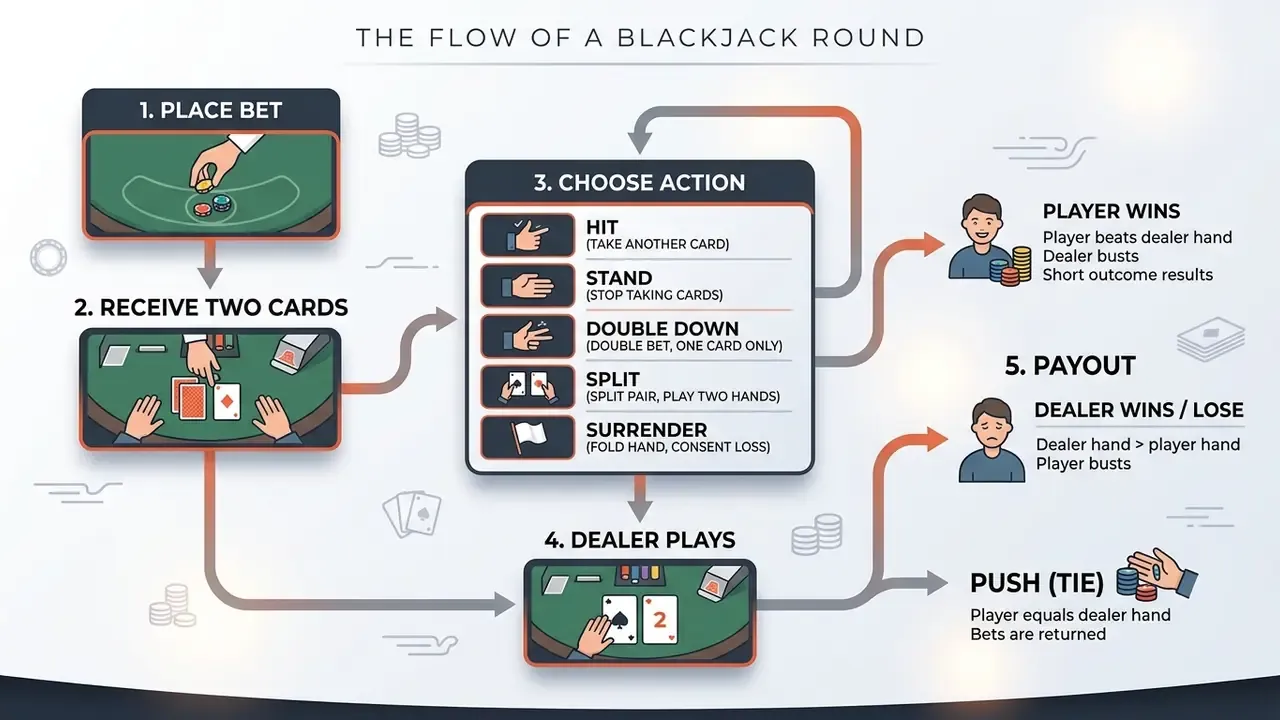
The flow of an online blackjack round

How to play blackjack step by step

Understanding the exact sequence of an online blackjack play prevents interface mistakes. Sounds basic, right? But fumbling with buttons mid-hand breaks your concentration, and that is when errors creep in.

From bet placement to the first two cards

Every round begins with the wager placement before any cards appear. You select your stake by clicking digital chips and placing them in the designated betting circle. Next, the software or live dealer distributes the first two cards to you, face up. The dealer receives two cards as well: one face up (the upcard) and one hidden (hole card).

Choose a base bet size carefully. A strong guideline is keeping wagers between 1% and 2% of your chosen session bankroll. For example, if your bankroll for the session is ₹10,000, your standard bet should sit between ₹100 and ₹200. This approach gives you enough hands to ride out short-term variance without draining your funds in a few unlucky rounds.

From bet placement to the first

How to read your hand and choose the next move

Reading your hand involves adding your two card values and immediately checking the dealer's visible card. These two pieces of information together determine your optimal action.

Here is a practical example. If you hold a hard 16 and the dealer shows a 6, the dealer carries roughly a 62% chance of busting on a draw. In this scenario, you stand and let the dealer take the risk. Rushed decisions usually lead to unforced errors. Analyze the hand total, check the strategy chart, and execute your chosen action calmly.

The bust probabilities for one hit on hard hands are worth memorizing: 31% (12), 39% (13), 56% (14), 58% (15), 62% (16), and 69% (17). These numbers help you evaluate risk before every single decision. Once you internalize them, playing blackjack starts to feel less like guessing and more like problem-solving.

How to read your hand and

Blackjack rules every player should know before playing

Blackjack rules govern exactly how cards are grouped and what decisions are mathematically viable. Failing to memorize these values instantly translates to lost wagers. No shortcuts here.

Card values: number cards, face cards and ace

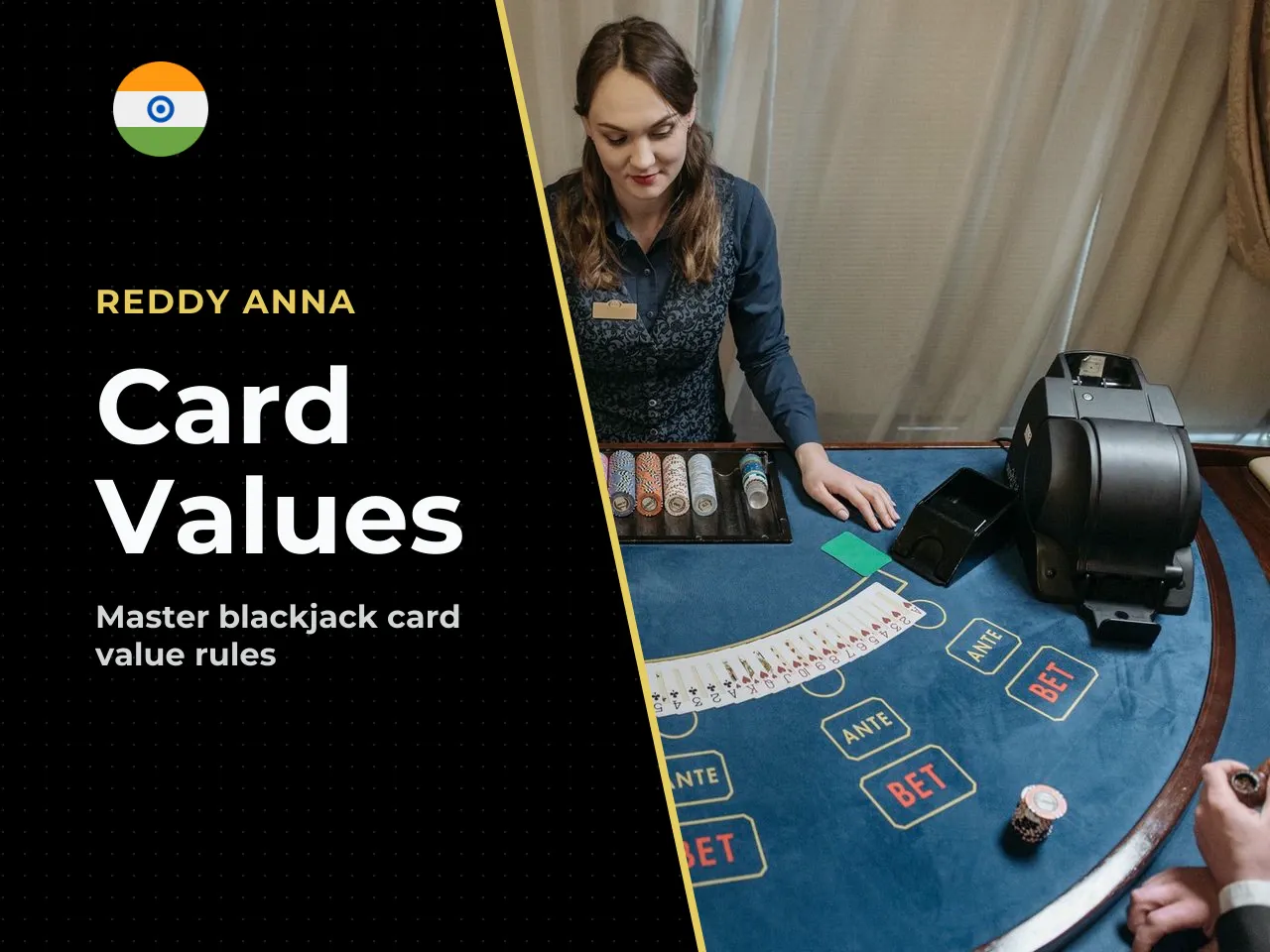
Card values in blackjack are fixed and do not depend on their suit. Number cards from 2 through 10 carry their exact face value. The face cards, specifically jacks, queens, and kings, all carry a value of 10.

The ace is the most flexible card because it acts as either 1 or 11. Your hand is considered "soft" when the ace counts as 11 without pushing the total over 21. The hand becomes "hard" once the ace must be forced to count as 1 to avoid a bust. Recognizing the difference between a soft total and a hard total defines your ability to play the game correctly. This distinction shapes nearly every strategic decision you will make.

Card values number cards, face cards

"Soft hands allow more aggressive drawing: an additional card cannot cause a bust as long as the ace can be re-evaluated from 11 to 1." - Online Blackjack: Rules, Formats, Strategy, and Evidence on Player Behavior, section 2.1 (2024).

Hit, stand, double, split, surrender and insurance

Your choices shape the risk and potential reward of every single round. Once the first two cards hit the table, you must select the correct mathematical action based on the dealer's visible card.
  • Hit:You take one additional card. You can repeat until you stand or bust.
  • Stand:You accept your current total and end your turn.
  • Double down:You double your initial bet in exchange for exactly one final card.
  • Split:If you receive a pair, you separate them into two different hands, requiring a second wager equal to your first.
  • Surrender:You forfeit the hand immediately, losing only half your bet. Not every table offers this option.
  • Insurance:A side bet offered when the dealer shows an ace.
Hit, stand, double, split, surrender and

A quick word on insurance. It is almost always disadvantageous. The bet is priced as if the probability of the dealer holding a natural is one-third, when the true probability is lower.

"Insurance is structured as though the dealer's hole card is a ten roughly 33% of the time; in a standard shoe the actual frequency is below that, making the side bet a consistent negative-expectation wager." - Online Blackjack: Rules, Formats, Strategy, and Evidence on Player Behavior, section 2.3 (2024).

From our experience analyzing user patterns, we noticed Indian players frequently lost session bankrolls rapidly by overusing the insurance bet. After publishing a basic strategy checklist advising players to reject insurance against a dealer ace entirely, users reported their funds lasting significantly longer. This confirmed that avoiding negative-expectation actions protects your budget in a tangible way.

Dealer rules, payouts and when the hand ends

The dealer does not make strategic choices and must strictly follow the house rules. Typically, the dealer draws cards until reaching a minimum total of 17.

A critical variation is whether the dealer hits or stands on a "soft 17." If the dealer must stand on all 17s, the player gains a slight statistical advantage. When the dealer is required to hit soft 17, the house edge increases slightly because the dealer improves the hand more often than busting.

"The requirement for the dealer to draw on soft 17 marginally increases the house advantage, as the dealer improves more frequently than the additional bust probability offsets." - Online Blackjack: Rules, Formats, Strategy, and Evidence on Player Behavior, section 2.4 (2024).

The hand ends immediately after the dealer finishes drawing. If the dealer busts, all surviving players win. Standard payouts deliver an even 1:1 on regular wins, while a dealer blackjack ends the round instantly unless you also hold a natural 21.

ActionMechanicsTypical AvailabilityImpact on Risk and Reward
HitTake one additional card; can repeat until stand or bust.Available on most hands.Increases chance of improving total but adds bust risk.
StandTake no more cards; lock in current total.Available on any hand total.Eliminates bust risk but may lose to a stronger dealer hand.
Double downDouble the bet, take exactly one card, then stand.Usually allowed on totals of 9, 10, or 11.Amplifies profit when favored but doubles the financial loss.
SplitTurn a pair into two hands, requiring an extra bet.Available on matching-rank cards.Better use of strong pairs (like aces) but doubles total stake.
SurrenderGive up the hand directly and lose half the bet.Offered at some online tables.Reduces expected loss in mathematically poor matchups.
InsuranceSide bet that the dealer holds a natural blackjack.When dealer shows an ace.Usually a negative-expectation bet; generally worth avoiding.

Table: Core Player Actions in Online Blackjack. Every player should understand these operations before committing funds.

Blackjack terminology cheat sheet

Before you sit down at any table, digital or live, learn the lingo. This glossary prevents confusion and helps you follow dealer calls instantly.
  • Bust -Going over 21. If you bust, your hand loses immediately, regardless of what the dealer holds.
  • Push -A tie between player and dealer. No chips move; your bet stays for the next round.
  • Upcard -The dealer's face-up card, visible to everyone at the table.
  • Hole card -The dealer's face-down card that stays hidden until the dealer's turn.
  • Soft hand -A hand containing an ace counted as 11 (e.g., Ace + 6 = soft 17). It can adjust downward if you draw a high card.
  • Hard hand -A hand without an ace counted as 11 (e.g., 10 + 7 = hard 17). The total is fixed.
  • Natural -An ace combined with a 10-value card on the first two cards. This is the classic blackjack hand.
  • Shoe -The device (physical or virtual) that holds multiple decks from which cards are dealt.
  • Bet Behind -A feature in some live dealer tables that lets you wager on another player's hand when all seats are taken.
  • Cut card -A plastic card inserted into the shoe to mark the point where the dealer stops dealing and reshuffles. In live blackjack games, the position of the cut card affects how deep into the shoe the game goes before a new shuffle.
Blackjack terminology cheat sheet. Before you

Knowing these terms makes it easier to keep up with the game and understand strategy discussions, table rules, and payout announcements. It also helps when reading forums or watching tutorial streams.

Blackjack strategy for beginners: the basic decisions that matter most

Basic blackjack strategy is a documented mathematical system, originally formalized by Edward Thorp in his 1962 book Beat the Dealer. It is designed to lower the house edge by telling you the statistically best action for every possible hand combination. Following it stops you from making choices based on fear or gut feeling.

Strong basic plays to memorize first

A solid strategy dictates unconditional rules you must always execute:

  • Always stand on a hard 17 or higher. The risk of a bust is too extreme (69% on hard 17).
  • Always hit hard 8 or less. You cannot bust, and any card improves the hand.
  • Always split aces and eights. Splitting aces gives you two chances at a strong hand starting from 11; splitting eights avoids the weak total of 16.
  • Never split 10s or 5s. A pair of tens is already 20 (one of the strongest hands), and a pair of fives totals 10, which is better doubled than split.
  • Stand on 12 through 16 if the dealer shows 2 through 6. The dealer's bust probability is high in this range, so you let the dealer take the risk.
  • Hit on 12 through 16 if the dealer shows 7 through Ace. The dealer likely has a made hand of 17+, so you need to improve.
  • Double down on 11 when the dealer shows 2 through 10. You have the best chance of drawing a 10-value card for a total of 21.
  • Play soft hands (Ace-2 through Ace-6) aggressively. Hit or double until you reach at least soft 18, because the flexible ace protects you from busting.
Strong basic plays to memorize first

"Simulations of standard six-deck blackjack with consistent basic strategy application show a house edge of approximately 0.5% under 3:2 payout rules." - Online Blackjack: Rules, Formats, Strategy, and Evidence on Player Behavior, section 3.1 (2024).

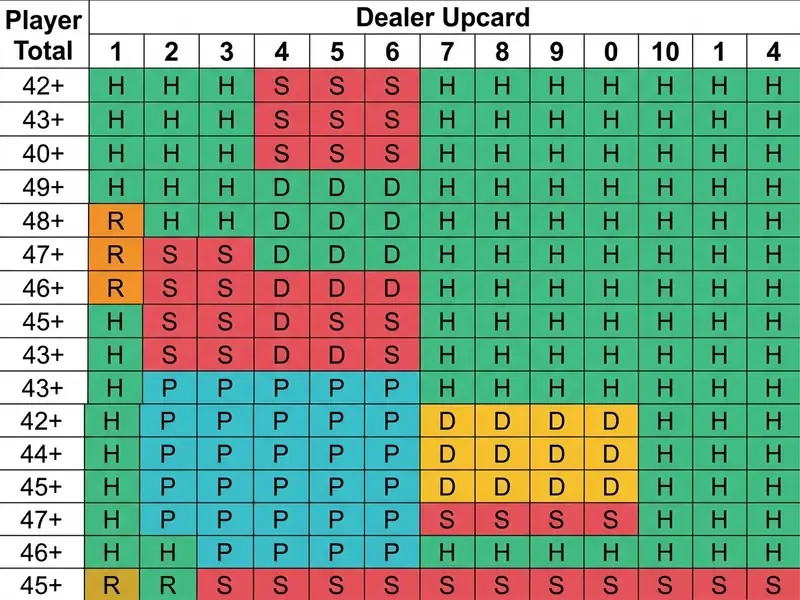
Basic strategy cuts the blackjack house edge from over 2% (intuitive play) down to roughly 0.3% to 0.6% under favorable rules. That is a reduction of about 1.5 percentage points on every bet you make. Over hundreds of hands, the difference is substantial.

Keep this chart open on a second screen or printed beside your device during play

Common mistakes that make players lose more money

Emotional reactions push casual players toward high-risk mistakes. A frequent error is flat betting out of boredom or randomly doubling bets to recover previous losses. Disregarding the dealer's upcard and treating a soft 18 like a hard 18 consistently drains bankrolls. You must view every hand analytically. Never buy insurance in an RNG game, as it strictly increases the house edge against you.

"Treating casino play as entertainment, not an income source, is your strongest defense against poor decisions." - Nisha Rao, Casino and Betting India.

"Experimental research showed that overconfident players place larger bets, use strategy aids less frequently, and overestimate their probability of winning." - Online Blackjack: Rules, Formats, Strategy, and Evidence on Player Behavior, section 4.2 (2024).

Other common beginner mistakes to avoid:

  • Placing side bets without knowing the odds. Many optional wagers carry a significantly higher house edge than the main blackjack game.
  • Playing emotionally after a loss. Chasing losses by increasing bet size leads to rapid bankroll depletion. This is, frankly, the single fastest way to empty your account.
  • Standing too early against strong dealer cards. When the dealer shows 7 through Ace, staying put on a weak hand gives you almost no chance of winning.
  • Ignoring table rules like 6:5 payouts. A 6:5 table pays less for blackjack than 3:2, which increases the house edge and erodes your returns over time.

[✅ CHECKLIST: Beginner checklist before playing blackjack for real money]

  • Read and memorize what face cards, numbers, and aces equal.
  • Play a blackjack demo session for at least 30 minutes.
  • Set a strict INR session budget before logging in.
  • Keep a basic blackjack strategy chart open on your screen.
  • Avoid the insurance side bet completely.
  • Confirm the table pays 3:2 on naturals, not 6:5.
Other common beginner mistakes to avoid

Blackjack demo, free play and real money: which format to choose

Selecting the right playing mode dictates your financial exposure. Test modes are designed for strategy validation, while real-money blackjack games demand emotional discipline and strict bankroll management. Understanding the difference before you start is more important than most guides let on.

When blackjack demo is the best starting point

A blackjack demo acts as a financially safe training environment. You use virtual credits, meaning there is zero financial risk. Free blackjack play lets you memorize the hit and stand rules, practice identifying face cards quickly, and grow accustomed to the software interface. Most online casinos let you access demo mode without registration. Simply look for a "Play for Fun" or "Practice Mode" button in the game lobby.

"Participation in simulated games without real stakes helps players learn mechanics; however, research also documents an association between demo play and subsequent transition to real-money gambling." - Online Blackjack: Rules, Formats, Strategy, and Evidence on Player Behavior, section 3.3 (2024).

You should transition to real money only after reaching a point where strategy execution feels automatic. Demo mode is your training ground. Treat it seriously, follow the basic strategy chart as if real money were on the line, and track your results mentally. If you find yourself making the same mistake repeatedly in demo, you are not ready for real stakes yet.

What changes when you switch to real money blackjack

Switching to blackjack real money introduces tangible financial risk and psychological pressure. The emotional weight of losing actual INR often triggers impulsive decisions, leading players to abandon mathematical logic. Real money formats demand discipline, adherence to a predetermined budget, and a strict walk-away point.

"Studies show that after immediate losses, players tend to place larger bets and play longer sessions, a classic loss-chasing pattern that accelerates bankroll depletion." - Online Blackjack: Rules, Formats, Strategy, and Evidence on Player Behavior, section 3.4 (2024).

Research in the psychology of gambling has documented that real monetary stakes change affect and risk-taking: positive affect after wins was associated with lower subsequent wagers, while problem gamblers demonstrated impaired decision-making driven by cognitive distortions. - Frontiers in Psychology (2018).

How the three formats compare at a glance

CriterionDemo (Free Play)RNG Real MoneyLive Dealer
Financial riskNone (virtual credits)Real INR at stakeReal INR at stake
Speed~200 hands/hr~180-250 hands/hr~50-70 hands/hr
Card counting viableNo (full reshuffle)No (full reshuffle)Rarely (continuous shuffle machines or 8-deck shoe with deep cut)
Best forLearning rules and strategyHigh-speed optimized playImmersive social experience
Stress levelMinimalModerate to highModerate (social pressure from dealer/chat)

Live dealer blackjack and live casino tables

Live dealer games merge digital convenience with physical equipment. This format appeals to users looking for transparency and the traditional pacing of a real table. If you have ever felt that clicking buttons against an algorithm lacks atmosphere, live blackjack might be what you are looking for.

Why players choose live blackjack

Players gravitate toward blackjack live dealer formats to observe actual human interactions. Real cards are drawn from a physical deck (the shoe) and scanned by Optical Character Recognition (OCR) cameras, which convert the recognized card into digital data in real time so the player interface stays synchronized with the physical deal.

"Comparative analysis shows that live dealer blackjack carries a house edge of 0.4% to 0.7% under standard rules, comparable to the RNG format when rules are identical." - Online Blackjack: Rules, Formats, Strategy, and Evidence on Player Behavior, section 3.2 (2024).

Among live casino software providers, Evolution Gaming is the dominant force in the Indian market. Evolution's Live Blackjack carries a theoretical RTP of 99.29% with optimal basic strategy, and side bets such as Perfect Pairs (95.90% RTP) and 21+3 (96.30% RTP). Pragmatic Play and Ezugi are also popular alternatives, each streaming from dedicated studios with Hindi-speaking dealers in some rooms.

However, it is important to note something:

"Product-level analysis found that live table games are more strongly associated with harmful gambling markers than simulated (RNG) table games." - Online Blackjack: Rules, Formats, Strategy, and Evidence on Player Behavior, sections 4.4 and 6.3 (2024).

The social interaction element, dealer chat, other players betting alongside you, creates an immersive atmosphere that mirrors physical venues. But this immersion also increases session duration and emotional engagement. That is worth being honest about.

Disclaimer: Live casino games may carry a heightened risk of problem gambling behavior due to their immersive nature. Set firm session time limits and use the responsible-gambling tools provided by the platform.

What to check before joining a live dealer table

Before you take a seat at a live casino blackjack table, verify your practical setup:

  1. Internet connection: Live HD streams demand stable bandwidth. A minimum of 5 Mbps download is functional; 10 Mbps or higher is recommended for uninterrupted HD quality. Latency causes missed betting windows, and there is nothing more frustrating than losing a hand because your connection dropped.
  2. Table betting limits: Ensure the minimum and maximum bets align directly with your bankroll. Some platforms allow wagers from ₹100, while high-roller rooms can reach ₹10,00,000 per hand.
  3. Available seats: Live tables have limited capacity. If all seats are full, some providers offer Bet Behind, a feature letting you wager on another player's hand.
  4. Chat and dealer interaction: Confirm there is an active text chat for direct dealer communication. A friendly, responsive dealer improves the experience and can clarify table-specific rules on the spot.
  5. Mobile compatibility: Verify that the interface quality supports your phone screen effectively. Many Indian players access live tables primarily via smartphone, so this is not a minor detail.
What to check before joining a
Beyond the classic game described above, online casinos offer several blackjack variations, each with a distinct twist. Knowing the differences helps you pick the variant that suits your style and strategic comfort level.
  • European Blackjack -The dealer receives only one card face up initially and does not take the hole card until all players finish their turns. This means you cannot know if the dealer has a blackjack before making your decisions. Played with two decks, it typically carries a slightly higher house edge due to the no-hole-card rule.
  • Atlantic City Blackjack -Played with eight decks, the dealer stands on all 17s, and late surrender is allowed. The late surrender option is especially valuable when you hold 15 or 16 against a dealer 10 or Ace.
  • Blackjack Switch -You play two hands simultaneously and may swap the second card of each hand, creating stronger combinations. In exchange, a natural blackjack pays only 1:1 and a dealer 22 pushes against all non-busted hands instead of being a bust. It is a creative variant, though the altered payout structure changes the math significantly.
  • Blackjack Surrender -This variant prominently offers early or late surrender as a core feature, letting you forfeit weak hands against strong dealer upcards for half your bet. It is ideal for players who prefer a more conservative bankroll-preservation approach.
Popular online blackjack variations. Beyond the

Each variant carries its own optimal strategy adjustments, so always check the specific table rules before sitting down. The basic strategy chart you memorized for classic blackjack will need minor tweaks depending on which version you play.

How to choose a blackjack casino or online site

Before you trust a platform with your money, you must scrutinize their payout logic and security signals. A visually pleasing interface means nothing if the withdrawal policy traps your funds. This is where many beginners make costly mistakes.

Game selection, limits, mobile play and payment flow

Prioritize a blackjack casino offering varied limits that suit both testing and sustained play. Mobile usability is crucial for Indian audiences who play primarily via smartphones. Fast loading times and an intuitive lobby are clear green flags.

"Research found that the probability of problem gambling symptoms was higher among those who gambled via smartphone apps (OR 3.23, 95% CI 1.21-8.60)." - Online Blackjack: Rules, Formats, Strategy, and Evidence on Player Behavior, section 4.4 (2024).

This does not mean you should avoid mobile play. It means you should be especially disciplined when playing on the go. Use built-in session timers and deposit limits if the app supports them. The convenience of mobile blackjack is a double-edged sword: easy access also means easy impulse betting.

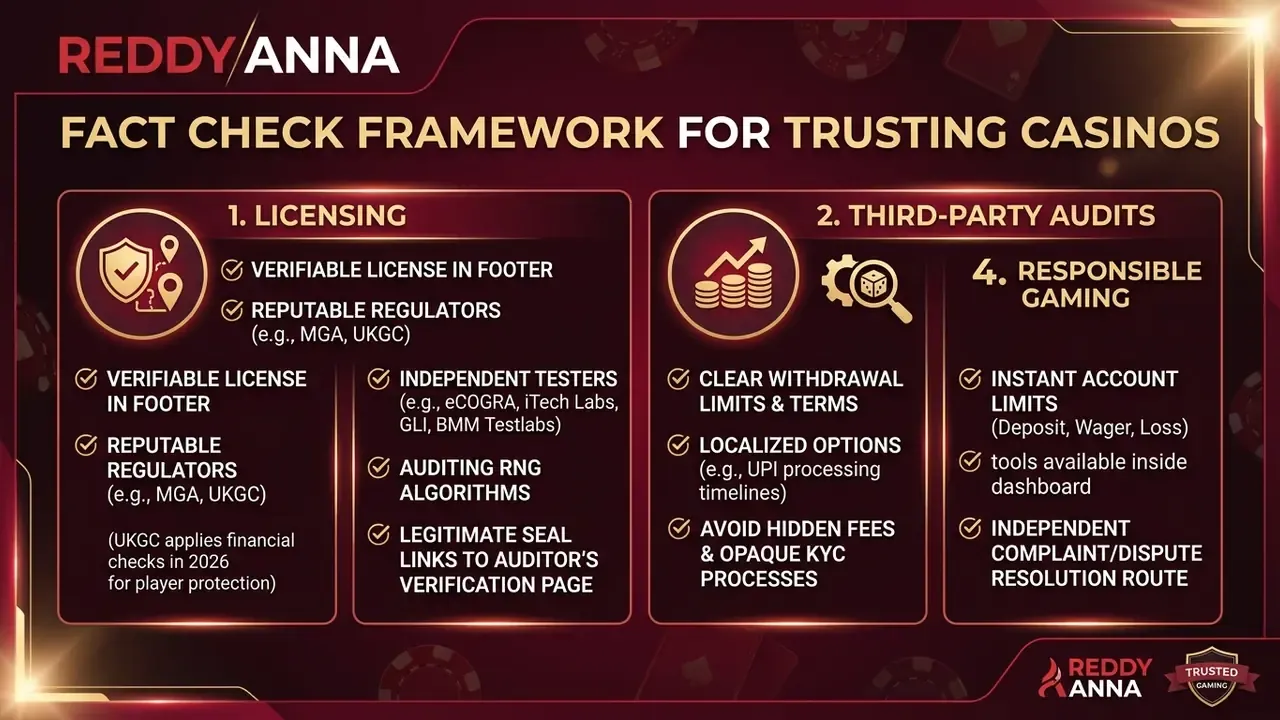
Additionally, you must verify the banking terms. Compare payout speeds, ensure the site processes INR smoothly through UPI or NetBanking, and read the KYC requirements beforehand to prevent document delays during cashouts.

We previously audited a new casino platform attracting users with flashy banners. However, testing the withdrawal flow revealed hidden fees and a strict KYC loop that delayed payouts by weeks. Providing an in-depth payment guide emphasizing platforms with transparent UPI integrations allowed our readers to bypass this friction entirely, ensuring smoother, localized financial safety. You can explore our detailed review methodology at our iGaming analysis hub.

Disclaimer: Online casino availability depends on local legislation. Always verify that the platform is licensed and accessible in your jurisdiction before depositing.

This does not mean you should

Bonuses, trust and responsible real money play

Assess bonus offers skeptically, especially for table games. Most welcome bonuses attach 100% wagering contributions to slot games, while live blackjack frequently contributes only 5% to 10%. This gap makes clearing the bonus requirements highly unrealistic for table game players.

Example wagering calculation for blackjack players: If a casino offers a ₹10,000 bonus with a 35x wagering requirement and blackjack contributes 10%, you must wager: ₹10,000 x 35 = ₹3,50,000 total required. But at 10% contribution, each ₹100 bet only counts as ₹10. So your real wagering volume needed is ₹35,00,000 (₹35 lakh), not ₹3,50,000. For most recreational players, this is simply impractical. Read the terms before claiming any bonus.

Reputation matters. Look for responsible gambling options like hard session limits and self-exclusion triggers. A reliable casino protects its users proactively, not as an afterthought.

Bonuses, trust and responsible real money

"A study of UK online casinos found that a mandatory 60-minute play break reduced spending immediately after the pause, but the effect did not persist into the next day's play." - Online Blackjack: Rules, Formats, Strategy, and Evidence on Player Behavior, section 4.5 (2024).

This means tools like session limits are helpful in the moment but not a substitute for personal discipline. Combine platform safeguards with your own pre-set rules. No tool can replace your own decision to stop.

FAQ about online blackjack