Baccarat Online: Rules, Strategy, Demo and Live Dealer Play

Last updated: July 2026

Disclaimer: This article is for informational and entertainment purposes only. It does not constitute financial, legal or professional gambling advice. Online gambling involves real financial risk. Always play responsibly, observe the legal age and jurisdictional restrictions that apply to you, and seek help from a licensed professional if gambling becomes a problem.

RTP

98.94%

Volatility

Low

Baccarat Online Rules, Strategy, Demo and

What Is Baccarat and How the Game Works

Baccarat is a comparing card game played between two hands, called "Player" and "Banker." The goal? Predict which hand finishes closer to a total of nine. Despite its aristocratic reputation, the logic is surprisingly simple. Cards are dealt, values are added, and the hand closest to nine wins. You do not control either hand. Your only job is to pick an outcome before the cards are revealed.

The origins of baccarat trace back to nineteenth-century French parlour games like chemin de fer and baccarat-banque. Historical analyses show that baccarat evolved from a three-sided parlour game of the early 1800s into a non-strategic casino format by the mid-twentieth century. Players stopped competing against each other and started competing against the house. That shift is what defines modern punto banco, the variant found in the vast majority of online casinos today.

Mathematically, the core mechanic is a comparison of two modulo-ten totals, with the possibility of a third card drawn under fixed rules. In game-theoretic models of the original chemin de fer, each player sees only the sum of their two cards, not the composition. This formal structure underlines something crucial: once the bet is placed, neither the player nor the banker makes any discretionary decision. The dealing rules run automatically, making baccarat one of the purest chance-based games in any casino.

What Is Baccarat and How the

Player, Banker and Tie Bets

Before any cards are dealt, you commit to one of three primary bets:

BetWhat It MeansStandard Payout
PlayerYou predict the Player hand finishes closer to 91 : 1 (even money)
BankerYou predict the Banker hand finishes closer to 91 : 1 minus 5% commission (effectively 0.95 : 1)
TieYou predict both hands finish with the same total8 : 1 (some casinos offer 9 : 1)

In online interfaces, this choice appears through clickable betting areas labelled "Player," "Banker" and "Tie," often with optional side bets such as Player Pair, Banker Pair, Big/Small and others. The interface typically shows a chip tray at the bottom of the screen. You select a denomination, then click on the betting area to place your wager. Many platforms include a traffic-light system: green when betting is open, yellow when time is nearly up, red when betting is closed.

Here is a behavioural insight worth knowing. Large-scale observational studies of real baccarat players have found that most follow streaks, increasing their bets on the continuation of sequences as those sequences grow. This "positive recency" or trend-following bias means players frequently place long-shot bets on Tie or shift to riskier side bets after winning streaks, rather than sticking with the mathematically stronger approach of consistently backing Banker.

Understanding these three primary bets and the emotional traps around them is the first step toward informed play.

In online interfaces, this choice appears

Card Values, Total and Winning Hand

Baccarat uses a distinctive scoring system built around the last digit of a hand's total:

CardValue
2 through 9Face value
10, Jack, Queen, King0
Ace1

If a hand's combined total exceeds nine, only the last digit counts. Three worked examples:

  1. 4 + 5 = 9 - a "natural" nine, the best possible hand.
  2. 6 + 7 + King = 13, so 3 - the tens digit is dropped.
  3. 9 + 9 = 18, so 8 - another strong hand despite the raw total being 18.

This modulo-ten arithmetic means no hand can ever "bust" the way it can in blackjack. Every total falls between 0 and 9. A hand of zero, sometimes called "baccarat" itself, simply counts as the lowest possible score.

Baccarat Rules Every Beginner Should Know

If you want to play baccarat with any confidence, the rules are where you start. The good news: they are short and completely fixed. No judgement calls, no bluffing, no complicated decision trees.

How a Baccarat Round Starts and Ends

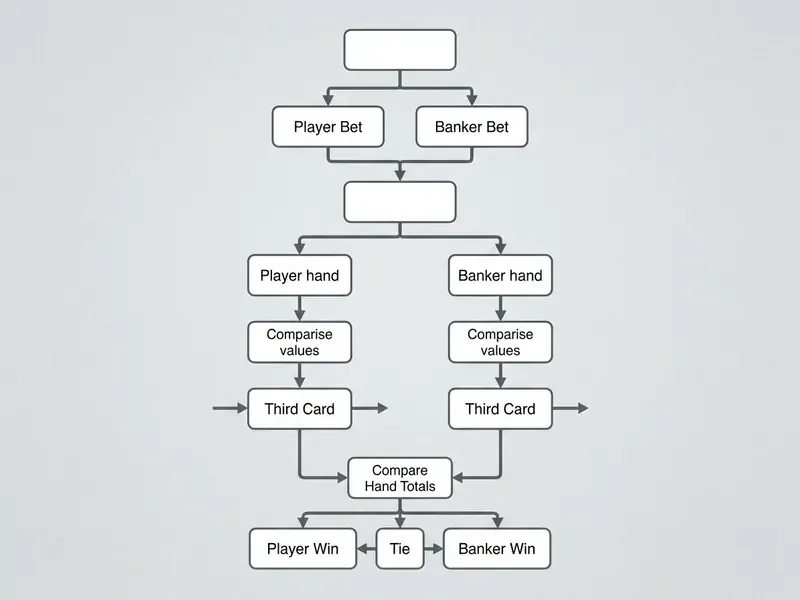
A standard punto banco round follows five fixed steps, with no deviation:

  1. Bets are placed. The table opens for wagers on Player, Banker or Tie, plus any available side bets. Once the timer or dealer closes betting, no changes are allowed.
  2. Initial deal: two cards each. The dealer distributes four cards face-up in alternating order. First card to the Player box, second to the Banker box, third to the Player box, fourth to the Banker box.
  3. Check for naturals. If either hand totals 8 or 9, the round ends immediately. No third card is drawn. If both hands are natural, the higher natural wins. Identical naturals produce a Tie.
  4. Third-card rules (if no natural). The Player hand is evaluated first: totals 0 through 5 draw a third card, totals 6 or 7 stand. The Banker's draw then depends on its own two-card total plus the specific value of the Player's third card (see the chart below).
  5. Comparison and payout. The hand with the higher final total wins. Winning Player bets pay 1 : 1. Winning Banker bets pay 1 : 1 minus 5% commission. Tie bets pay 8 : 1 (or 9 : 1). The dealer collects losing wagers.

Third-card drawing rules for the Banker:

How a Baccarat Round Starts and
Banker's 2-Card TotalBanker Draws When Player's Third Card IsBanker Stands When Player's Third Card Is
0 through 2Any card-
30-7, 98
42-70, 1, 8, 9
54-70-3, 8, 9
66-70-5, 8, 9
7StandsAny card
8 or 9Natural: round already ended-

If the Player stood (total 6 or 7), the Banker simply draws on 0 through 5 and stands on 6 or 7, identical to the Player rule.

Does this chart look complex? It does. But here is the thing: you never need to memorise it. The dealer or the software executes every step automatically. The player never decides whether to draw.

What the Dealer Controls During the Game

The dealer, whether a live human on camera or a software algorithm, bears full procedural responsibility. Their duties include accepting wagers within the time window, dealing cards in the correct alternating sequence, applying the third-card rules without deviation, announcing results, paying winners and collecting losing bets. At no point does a baccarat player make a hit-or-stand decision. The entire round is deterministic once the shoe is shuffled.

A case study comparing RNG and live-dealer implementations found that RNG games offered players slightly better win probabilities and a marginally lower effective house edge, while live-dealer formats provided greater engagement and visual transparency through seeing physical cards dealt in real time. The practical difference in win probability was statistically significant but not large enough to be the primary driver of format choice.

One nuance worth noting is pace. RNG baccarat typically plays faster, allowing more rounds per hour. Because the house edge is applied on every hand, more rounds per hour can increase total exposure. Players who prefer a more measured tempo, and who value seeing a physical shuffle and deal, often gravitate toward live casino tables, where the natural cadence of a human dealer slows things down.

What the Dealer Controls During the

Baccarat Online, Demo and Real Money Play

Disclaimer: Gambling with real money carries financial risk. Set a budget you can afford to lose, and never chase losses. If you or someone you know is struggling with gambling, contact a licensed support service in your jurisdiction.

How Online Baccarat Works in Practice

The online gambling market is estimated at over USD 100 billion in 2026, with casino games representing approximately 50% of total revenue. Within this landscape, baccarat is available on many iGaming platforms, with most operators offering both demo (free-play) and real-money modes.

Demo mode uses a virtual bankroll, typically credited automatically, so the player risks nothing. It runs on the same RNG software as the real-money version and exposes the same interface, betting areas and rule logic. Its purpose is practice: learning how totals work, observing the third-card process, and getting comfortable with the platform's layout before committing funds.

Real-money mode requires a deposit through a verified payment method and subjects the player to the casino's terms, including wagering requirements on any bonus funds. Winnings are withdrawable after meeting those terms.

How Online Baccarat Works in Practice
Baccarat demo vs real money: key differences
ParameterDemo / Free PlayReal Money
Primary goalPractice and learningWagering for withdrawable winnings
Financial riskNone (virtual bankroll)Real monetary loss possible
Betting featuresFull access to interfaceFull access with actual stakes
Learning valueHigh, no pressureLower, stakes create emotional pressure

A report on simulated online gaming practice modes found that participants in a "profitable practice" condition, where the demo returned 150% of wagered amounts, subsequently staked more real money than participants in a control group. This finding underscores a critical caveat: demo sessions that deliver artificially generous results can create optimistic expectations that do not survive contact with real house-edge math.

A separate case study of demo versions in digital slot games emphasises that demo modes act as virtual playgrounds, allowing players to familiarise themselves with game mechanics, bonus features and volatility patterns without financial risk. The same principle applies to baccarat demos, which let newcomers experience the card-drawing process, observe how payouts work and test different bet sizes at their own pace.

A report on simulated online gaming

When Baccarat Demo Is the Best Choice

Experts and industry guides converge on several scenarios where demo mode is strongly recommended:

  1. Learning the rules from scratch. If you have never played baccarat, a demo round makes the modulo-ten scoring and automatic third-card draws tangible in a way that reading alone cannot.
  2. Testing a new platform or variant. Each software provider designs its interface differently. Microgaming's classic layout differs from Evolution's first-person view, which in turn differs from NetEnt's Baccarat Pro. A few demo rounds let you confirm that the controls, chip sizes and speed suit your preferences.
  3. Experimenting with bet sizing. Demo mode is the only risk-free way to observe how flat bets compare with progressive schemes over dozens of hands, without losing a single rupee.
  4. Recovering confidence after a losing session. Returning to demo play after real-money losses can reset emotional decision-making and help you refocus on process rather than outcome.

A key caveat: research on inflated demo returns shows that practice sessions at 150% payout rates developed positive expectations and a short-term increase in risk appetite during subsequent real-money play. Use demos to learn mechanics, but do not mistake demo results for a realistic forecast of what happens with real stakes.

When Baccarat Demo Is the Best

When to Switch to Baccarat Real Money

The readiness indicators most commonly cited by responsible-gambling educators include:
  • Rule fluency:You can explain the third-card chart without consulting a reference.
  • Bankroll plan in place:You have set a session budget, a stop-loss and a win goal before sitting down. A common guideline is to keep each betting unit at 1 to 2% of your session bankroll.
  • Emotional control:You do not chase losses or increase stakes after a losing streak.
  • KYC and payment method ready:Your account is verified, and your chosen deposit method (bank transfer, e-wallet, UPI, or other local option) is confirmed.
When to Switch to Baccarat Real

Research on approximately 4,000 baccarat players in a large East Asian casino found that betting amounts gradually increased according to streak length. The effect was more pronounced after consecutive wins than after consecutive losses. This pattern, a form of escalation and chasing, is precisely what a solid bankroll plan is designed to prevent.

Regulatory context matters too. The UK Gambling Commission's 2026 financial-risk assessment thresholds require operators to investigate when a customer's net deposits exceed £1,000 in 24 hours or £3,000 in 90 days (with lower thresholds for under-25s). In India, the legal landscape varies by state, with the Public Gaming Act 1867 providing a federal baseline while individual states set their own online-gambling rules. Always verify the legal status in your jurisdiction before playing with real money, and choose only casinos licensed by a recognised regulator.

Research on approximately 4,000 baccarat players

Live Dealer Baccarat and the Live Casino Format

How Live Baccarat Differs from Standard Online Baccarat

Live dealer baccarat is streamed in real time from a professional studio, typically equipped with 4K-capable cameras and adaptive bitrate streaming, where a human dealer conducts the game at a physical table. The player interacts through an overlay interface: selecting chips, placing bets on Player, Banker or Tie, and watching the deal unfold on camera.

The key differences from RNG baccarat:

CriterionRNG BaccaratLive Dealer Baccarat
Card generationSoftware RNGPhysical cards from a shoe
SpeedFaster, instant resultsSlower, human dealer pace
TransparencyCertified RNG; result is invisibleVisible deal on camera
Social interactionNoneChat with dealer and other players
Demo availabilityWidely availableGenerally not available for free play
Typical house edge (Banker)~1.06%~1.06% (same rules apply)

A case study examining win probabilities and variance between RNG and live-dealer implementations found that RNG games offered a slightly better chance for players, but the differences were not large enough to become the primary factor in format choice. The real differentiator is user experience: live dealer tables combine the convenience of online play with the reassurance of watching a real person handle real cards.

Modern live baccarat variants introduce creative twists. Lightning Baccarat, for example, randomly selects one to five "Lightning Cards" each round, adding multipliers of up to 512x on winning hands, though the adjusted Banker house edge rises to approximately 2.47%. Speed Baccarat compresses each round to roughly 27 seconds. Baccarat Squeeze slows the reveal down for dramatic effect, with the dealer (or, in "Controlled Squeeze," the player) peeling the cards gradually.

A case study examining win probabilities

Who Should Choose a Live Dealer Table

Live dealer baccarat appeals most to players who value:

  • Visual trust. Seeing the shoe, the cards and the dealer's hands eliminates doubt about randomness.
  • Social atmosphere. The chat function and the dealer's spoken commentary recreate the communal energy of a land-based casino.
  • Paced play. The slower cadence of a live round, typically 40 to 60 seconds compared with 10 to 15 seconds for RNG, naturally limits the number of hands per hour. This also serves as a practical harm-reduction feature by reducing the rate at which stakes can be placed.
  • VIP and high-roller formats. Many live studios offer private tables with higher limits, personal dealers and loyalty perks.

Surveys of younger casino patrons, including millennials, have suggested that this demographic enjoys social and experiential features. A significant proportion plays table games like blackjack, roulette and poker, and prefers interactive environments, including playing alongside friends or family. Live dealer baccarat, with its human dealer and potential for chat, aligns with these preferences more than RNG baccarat does.

Who Should Choose a Live Dealer

Before committing real money at a live table, watch a few rounds in "observer" mode (available on many platforms) or try a Speed Baccarat demo in RNG first to get used to the timing. The pace of live dealing can feel either too fast or too slow if you have only played against a computer.

Live baccarat vs land-based vs online (RNG): quick comparison

FactorLand-Based CasinoOnline RNGLive Dealer Online
PrivacyLowHighHigh
ConvenienceLow (travel required)HighHigh
BonusesRareCommonCommon
High limitsYesVariesYes
Low limitsRareYesYes
InteractionFace-to-faceNoneChat + video
Demo / free playNoYesGenerally no

Punto Banco, Mini Baccarat and Other Common Formats

Punto Banco is the dominant form of baccarat in virtually every online casino. Its defining feature: player decisions are reduced to the initial bet. All card-drawing actions are governed by fixed rules. The game is typically dealt from an eight-deck shoe, and the house edge stands at 1.06% on Banker, 1.24% on Player and 14.36% on Tie.

The evolution of baccarat from aristocratic parlour game to contemporary casino staple is well-documented. The game journeyed from a three-sided parlour game of the early nineteenth century to a non-strategic casino format by the mid-twentieth century, where players compete against the house rather than against each other.

Here is a summary of the most commonly encountered variants:

Punto Banco, Mini Baccarat and Other
VariantKey DifferenceDecksNotable Rule
Punto BancoStandard fixed-rule format8Banker draws governed by third-card chart
Mini BaccaratSmaller table, lower limits, faster pace8Same rules and odds as Punto Banco; single dealer
Chemin de FerPlayers compete against each other; the banker role rotates6Player and banker may choose to draw on 5
Baccarat BanqueBanker plays simultaneously against two player hands3Banker is the player with the largest wager
European BaccaratPlayer may choose to draw or stand on 56Resembles chemin de fer with casino-funded banker
3-Card BaccaratBoth hands always receive 3 cards1Faster pace; winning player bets pay 97 : 100
MacaoPrecursor to modern baccarat; bet only on the player hand2Hands exceeding 9 go bust (no dropping tens digit)
Dragon TigerOne card per side; simplest format1Tie house edge is approximately 32.77%; main bet edge is 3.73%

Mini Baccarat deserves special mention for online players. It uses the same rules and odds as traditional Punto Banco but is played on a smaller table with a single dealer and lower betting limits. This operational simplicity makes it the default format in digital and live casino rooms, where fast rounds and accessible stakes are priorities.

Live and Casino-Focused Baccarat Variants

Live-dealer studios have introduced several format innovations. The most prominent include:
  • Lightning Baccarat (Evolution):Standard punto banco rules, plus 1 to 5 randomly drawn Lightning Cards per round that carry multipliers up to 512x. Winning hands that match a Lightning Card pay the multiplied amount. The trade-off is a slightly higher house edge (approximately 2.47% on Banker) to fund the multiplier pool.
  • Speed Baccarat:Rounds last roughly 27 seconds. Ideal for experienced players who want a high volume of hands.
  • Baccarat Squeeze / Controlled Squeeze:The reveal is slowed for theatrical effect. In Controlled Squeeze, the player controls the peel-back of the card corners, a small tweak that significantly heightens immersion.
  • No Commission Baccarat:Removes the standard 5% commission on Banker wins. Instead, if Banker wins with a total of 6, the payout is typically 0.5 : 1 rather than 1 : 1. The adjusted Banker house edge is approximately 1.46%.
  • Progressive Baccarat:A progressive jackpot is funded by an optional side bet each round. The main game plays by standard punto banco rules.
Live and Casino-Focused Baccarat Variants. Live-dealer

Industry standard practice in live-dealer rooms is to offer additional side bets such as Player Pair, Banker Pair, Perfect Pair and Big/Small. These side bets provide higher payouts (a Perfect Pair may pay 25 : 1, for example) but carry substantially higher house edges than the main wagers, so approach them with caution.

Top baccarat software providers in 2026:

ProviderNotable Baccarat TitlesHighlights
EvolutionLightning Baccarat, Speed Baccarat, Baccarat Squeeze, Controlled SqueezeMarket leader in live-dealer formats; 4K streaming, multiplier mechanics
MicrogamingBaccarat Gold, Classic BaccaratOne of the industry's oldest providers (founded 1994); clean, straightforward RNG interface
NetEntBaccarat ProLaunched 2011; smooth graphics, available in both RNG and live variants
Pragmatic PlayLive Speed Baccarat, No Commission BaccaratGrowing live-casino portfolio with competitive low-latency streaming
BetSoftBaccaratVisually polished RNG version with standard rule set
Play'n GOMini BaccaratSmooth performance, beginner-friendly lower stakes
IGTElectronic BaccaratBridges land-based electronic table games with online RNG versions

Baccarat Strategy: What Matters and What Does Not

Let's be honest. This is the section most people skip to. And it is also the section most likely to disappoint, because the truth about baccarat strategy is not glamorous.

Structural House Edge and the Limits of Strategy

Baccarat's house edge is embedded in its dealing rules and commission structure. No betting system or play strategy can change the long-term expected value of betting on Player, Banker or Tie.

BetHouse EdgeWin Probability (excl. ties)Payout
Banker1.06%~50.68%0.95 : 1 (after 5% commission)
Player1.24%~49.32%1 : 1
Tie14.36%~9.6%8 : 1

The Banker bet has the lowest house edge because the third-card rules give the Banker hand a slight structural advantage: it acts second and its draw conditions respond to the Player's third card. The 5% commission exists precisely to offset this advantage. Even after the commission, Banker remains the mathematically superior bet.

Game-theoretic analysis of baccara chemin de fer confirms that equilibrium strategies in the older, decision-based variant still do not produce positive expected value. And those equilibrium insights emphatically do not carry over to the modern, non-strategic punto banco format, where the house edge is fixed.

The Banker bet has the lowest
Baccarat strategy trade-offs at a glance

Banker, Player and Tie from a Strategy Perspective

Banker is the optimal main bet purely on expected value. The mathematically optimal basic strategy in punto banco is to bet on Banker every hand, because it minimises the house edge to 1.06%. This is endorsed by probability theorists, including Michael Shackleford (Wizard of Odds), who explicitly states that no betting system changes the house edge.

Player is a reasonable alternative for players who dislike paying the 5% commission, but the gap in expected value is real: 1.24% versus 1.06%.

Tie offers a tempting 8 : 1 payout, but the mathematics are unforgiving. At a real probability of approximately 9.6%, the break-even payout for a Tie bet would need to be roughly 9.4 : 1. Since the standard payout is only 8 : 1, the expected return per unit staked is 0.096 x 8 minus 0.904 x 1 = negative 0.136, yielding a house edge of approximately 14.36%. In practical terms: for every ₹100 wagered on Tie over the long run, you can expect to lose roughly ₹14.

Behavioural research reinforces this: most baccarat players exhibited trend-following bias, betting on the continuation of outcome streaks rather than on reversals. As streaks lengthened, players increasingly bet on the continuation of past consecutive outcomes, and wagered amounts rose modestly but consistently. After consecutive losses, the proportion of multiple bets and long-shot wagers (including Tie) decreased, while after consecutive wins it increased, a pattern interpreted as chasing and risk escalation.

Banker, Player and Tie from a

Common Betting Systems and Realistic Limits

Two progressive systems are commonly marketed for baccarat:

Martingale: Double your bet after every loss; return to the minimum after a win. The logic is that a single win recovers all prior losses plus one unit of profit. The fatal flaw is exponential growth: after six consecutive losses starting from ₹100, the seventh bet would be ₹12,800, which may already exceed the table's maximum. A losing streak of eight or nine hands is uncommon but entirely possible, and when it occurs the system collapses.

"No betting system changes the house edge." - Michael Shackleford, Wizard of Odds

Paroli (Reverse Martingale): Double after each win; reset to the base bet after a loss or after three consecutive wins. Paroli limits exposure during losing runs but does not alter expected value. A long adverse streak still resets all accumulated progress.

No peer-reviewed baccarat-specific study in the recent literature has empirically tested these systems under real-world table-limit and bankroll constraints. However, empirical data on real players paints a telling picture: betting amounts grew in proportion to streak length, even after losing streaks, effectively running informal Martingale-like progressions without calling them that.

The mathematical reality is that any system applied to a negative-expectation game will, on average, lose in proportion to the total amount wagered, regardless of bet sizing. Flat betting on Banker remains the simplest approach that minimises the house edge.

Fact-checking common myths:

Myth 1: "Baccarat is pure luck, strategy is pointless." Partially true, partially misleading. Baccarat outcomes are indeed random, and no strategy can predict or influence which cards appear. But treating baccarat as pure luck without any mathematical structure can reinforce impulsive behaviour and reliance on superstitions. A mathematically informed player knows that Banker is the better bet, that Tie should be avoided, and that bankroll management directly affects how long and how safely they play.

Myth 2: "A betting system can guarantee profits." False. As confirmed by Shackleford and multiple probability analyses, no staking plan overcomes the house edge. Pattern-reading at the table is, in Shackleford's words, "a waste of time."

Myth 3: "Casino bonuses let you play baccarat risk-free." Misleading. In most online casinos, baccarat contributes a very small percentage, often 5 to 10%, sometimes 0%, toward bonus wagering requirements, compared with 100% for slots. A ₹10,000 bonus with a 30x wagering requirement and 5% baccarat contribution would require ₹6,000,000 in baccarat wagers to clear. Always read the full terms before assuming a bonus applies to table games.

Research on promotional free-play in casinos found that such offers did not significantly increase player losses or play time. Results were most consistent with prospect-theory-with-memory editing, in which players folded promotional credits into their mental accounting without treating them as a windfall to gamble recklessly.


Paroli Reverse Martingale Double after each

Disclaimer: No betting system guarantees a profit. Gambling is a form of entertainment with an inherent cost equal to the house edge multiplied by total wagered. Budget accordingly.

How to Choose a Baccarat Casino or Live Baccarat Site

Game Selection, Dealer Quality and Software

Before depositing money at any online casino, verify the following:

#CriterionWhat to Check
1Valid licenceThe casino holds a current licence from a recognised regulator (e.g., MGA, UKGC, Curacao eGaming, Gibraltar). Cross-reference the licence number against the regulator's public register.
2Independent RNG / RTP auditLook for certification from eCOGRA, iTech Labs, GLI or BMM Testlabs. The audit report should not be expired.
3SSL / HTTPS encryptionConfirm that every page involving personal data or payments uses HTTPS.
4Licensed software providersBaccarat games should come from verifiable, licensed studios (Evolution, Microgaming, NetEnt, Pragmatic Play, etc.) with published RTP values.
5Transparent withdrawal termsPublished payout timescales, limits and conditions. No hidden restrictions. Target: withdrawals processed within 72 hours.
6Identifiable operatorThe owning company, legal entity and registered address are disclosed and consistent with the licence.

The range of baccarat games matters too. A casino that offers only one or two RNG titles and no live dealer tables is limiting your options. Look for platforms that carry at least a few variants: standard punto banco, Speed Baccarat, Lightning Baccarat and perhaps No Commission Baccarat. The presence of multiple reputable software providers (Evolution for live, Microgaming or NetEnt for RNG) is itself a trust signal.

For live dealer quality, check whether the studio streams in HD or 4K, whether the dealer speaks clearly, and whether the interface responds without noticeable lag. A few minutes in observer mode can tell you a lot.

Red flags to watch for:

  1. Excessive wagering requirements on baccarat bonuses. If the wagering multiplier exceeds 50x, or if baccarat's contribution is 0%, the bonus is functionally useless for table-game players.
  2. Unexplained withdrawal delays. Payouts routinely taking longer than 72 hours without a stated reason, or accounts being closed without explanation, are serious warning signs.
  3. Unverifiable licence. If the licence number is not listed in the regulator's public database, do not deposit.
The range of baccarat games matters

Bonuses, Payments and Mobile Access

Payment methods for Indian players:

Many offshore online casinos accept Indian players and support local payment methods including UPI, Paytm, PhonePe, and bank transfers in INR. Before playing:

  • Confirm that the casino accepts deposits and withdrawals in Indian rupees to avoid unfavourable currency conversion fees.
  • Complete KYC (Know Your Customer) verification early, submitting ID and proof of address, so that withdrawals are not delayed when you win.
  • Start with a small deposit to test the platform's payout speed and customer support responsiveness before committing larger amounts.

Wagering contribution: baccarat vs slots

A critical point for bonus hunters. In most online casinos, wagering contribution rates differ dramatically by game type:

Bonuses, Payments and Mobile Access. Payment
Game TypeTypical Wagering Contribution
Slots100%
Blackjack10-20%
Baccarat5-10% (sometimes 0%)
Roulette10-20%

This means that a welcome bonus designed around slot play may be almost impossible to clear through baccarat. Always check the specific terms before opting in.

Mobile access is non-negotiable for most Indian players. Check whether the casino's baccarat games load smoothly in a mobile browser, whether a dedicated app is available, and whether the live dealer interface adapts to smaller screens without cutting off the betting areas. A laggy mobile experience during a live round can mean missed bets, which is frustrating and avoidable.

Quick Answers About Baccarat Before You Play FAQ

This guide is maintained by the editorial team and reflects data available as of July 2026. For questions about responsible gambling, visit BeGambleAware.org or contact a licensed support service in your jurisdiction.